Overall, I am extremely pleased with the final outcome of this project. Each track demonstrates a different genre of music where I have been successful in collaborating with a music producer to form these tracks and to learn new skills in music production. Connor was able to give me an insight into which techniques work best when creating songs and we were both able to fuse our ideas together to form something really special through these tracks. Although each track could have been made better in terms of the overall mix quality, I believe that we have still formed something positive, especially being able to create something in a pandemic which caused pressure and still being able to communicate online. As well as this, I believe that collaborating with Alex to create artwork for this EP, also gave me another insight into the industry. His positive influence and creativity formed a reliable relationship and I will be able to work again with Alex to collaborate on more exciting projects in future.
What could have gone better?
The mix of each track – EQ, Compression, levels (volume of vocals & instruments), etc.
The title of the EP – Could have explored something a bit more interesting and could have linked to the theme of each track (love themed)
Experimentation of lyrics or music first (as highlighted in blog 6) could have highlighted this more throughout
Creating two songs in Logic and two songs in Ableton
Researching into Copyright more and applying this to my realisation
BLOG 29 – FINAL REALISATION (PART ONE)
WHAT HAVE I LEARNT/EXPLORED: Collaboration, Individual & Contextual
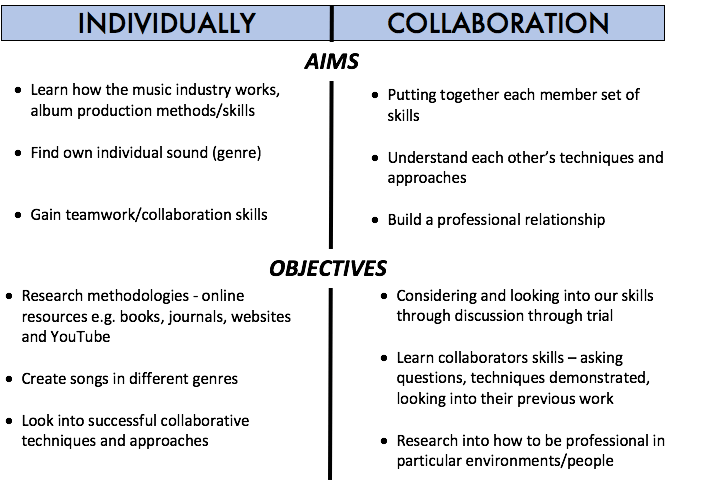
Looking back to blog 3, these were my collaboration and individual aims and objectives –
Figure 29.0. – Blog 3: Aims & Objectives
Below are the varying points that have been further achieved in this project, both in a collaborative way and an individual way –
COLLABORATION:
How to work with others in different industries – Art (Illustrator) and Music (Music Producer)
Forming reliable relationships which I will be able to use again in future!
Working together to form a positive realisation
Learning from their previous work, e.g. Connors previous collaborations and how he made his EP at dBs music
Sharing and communicating different ideas and skills > how to write songs music or lyrics first – both of our techniques
Fusion of preferred genres
Learning each others use of softwares (Logic Pro X and Ableton)
Learning and working together in another area of the music industry – Art
INDIVIDUAL:
Found my sound through exploring different genres – Pop and Greek Pop
Learnt new skills from music producer: how to mix (EQ, Compression), producing music through Ableton (not used before)
Understanding the music industry and promotional areas
Learning more about myself as an artist and understanding that there is a wide range of directions I can take for future projects
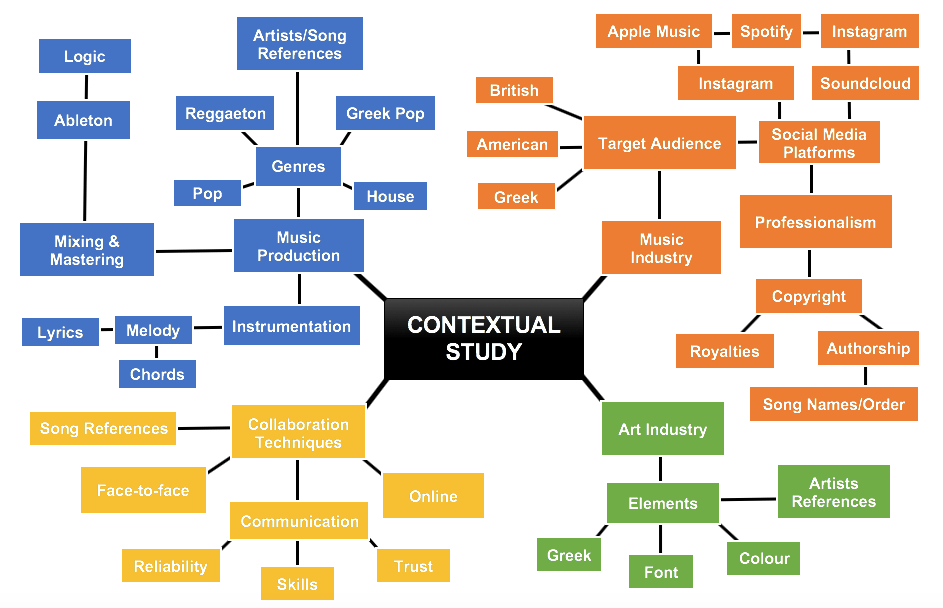
The mind map below also demonstrates all the contextual areas that I have looked into for this project in order to form the final realisation
Figure 29.1. – Contextual Study
Final Project Comments + Communication
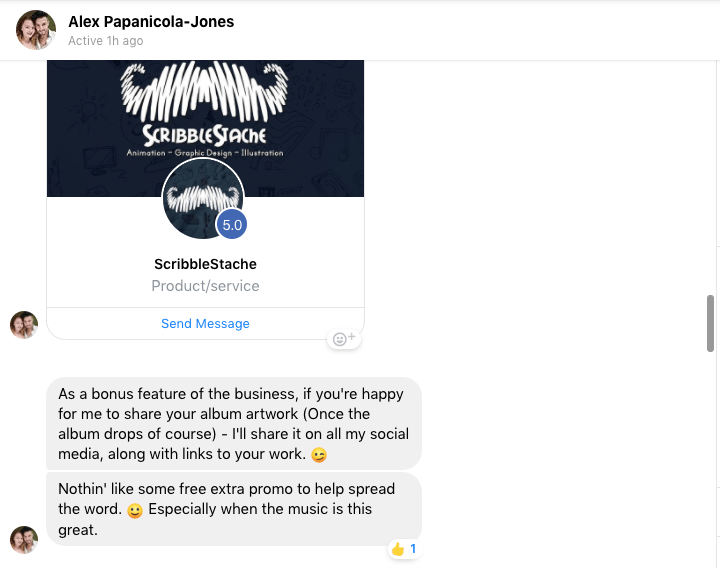
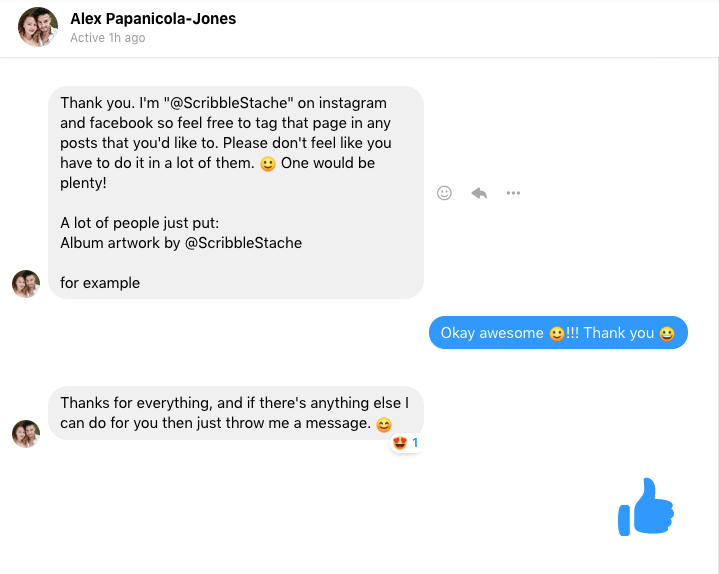
Illustrator –
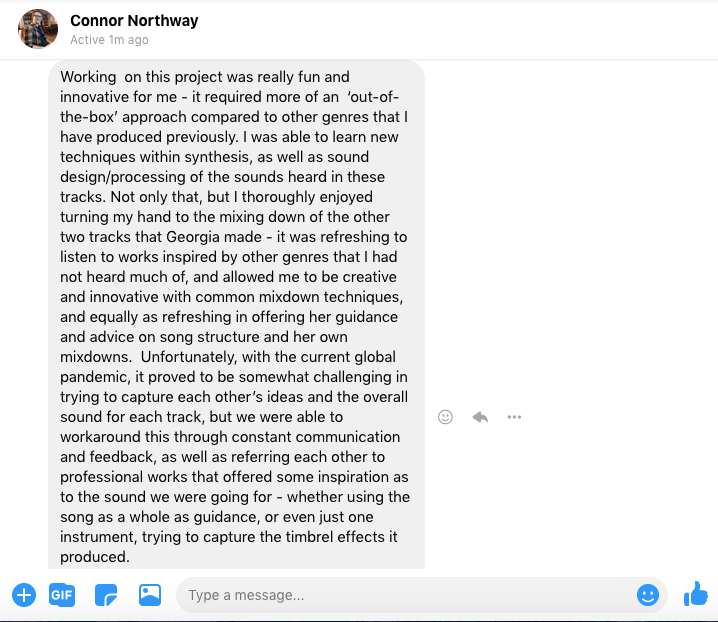
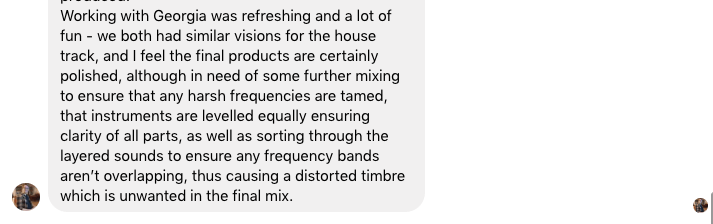
Music Producer –
Below is the final communication with Connor for this project where I have asked him how he feels the overall project went!
What Next?
My final steps now that I have discussed the finishing processes of the project with Connor and Alex, is to post each track onto Soundcloud and discuss how I feel about the overall project outcome (see next blog!).
BLOG 28 – FINAL CONTEXTUAL STUDY:
As I am now coming close to ending this project, it is vital that me and my collaborators consider copyright, royalties and authorship. These areas are vital to consider and to understand who has rights to the EP tracks. This is so that others do not claim credit for our work or use it illegally without permission. This is described by Marshall et al. (2013) who suggest that copyright comes in a number of forms. Copyright further highlighted by Slay (2011, p.880) who emphasises that ‘without copyright, songwriters and music publishers could not own and derive income from songs’.
COPYRIGHT & ROYALITIES
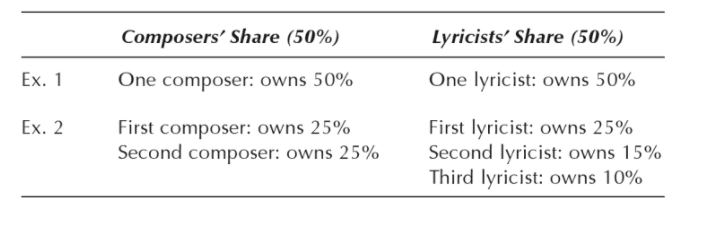
A written lyricist agreement may also follow as (see figure 29.0.), however this is most dependent on whether the Lyricist for the Greek track would like to be credited.
Figure 28.0. – Lyricist Rights Example
Source: Baskerville, 2006, p.92
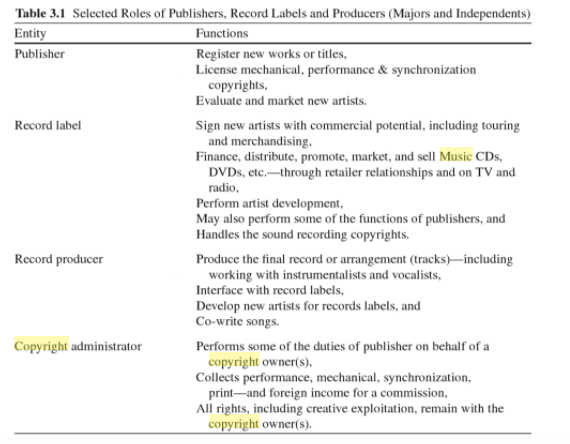
Figure 29.1. also demonstrates the various areas of the music industry in terms of Majors and independent artists, as well as how copyright works in this sense:
Figure 28.1. – Music Industry Areas
Source: Pitt, 2010, p.66
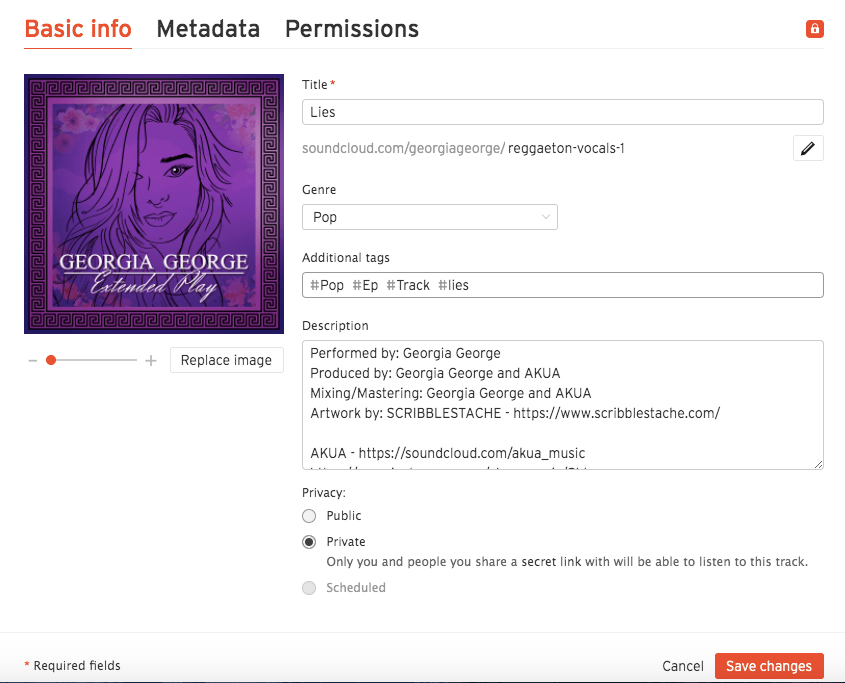
In terms of my project however, it is important that I give credit both to Connor the music producer for all four tracks and my brother who wrote the lyrics for the Greek track. This is something that me and my collaborators have discussed, but because this is a university project and an experiment into how collaboration works in the industry, we will mainly focus on authorship. This is mainly because we want to gain followers/fan base which will be done by (see figure 29.0):
Figure 28.2. – Authorship/Credit Example
What Next?
Now that I have looked into copyright and what I will do to credit my collaborators, it is now important that I begin to wrap up the final stages of the track. This will need to be done by listening through each track once more, then uploading and organising all information for each track on Soundcloud.
Reference List:
Baskerville, D. (2006). Music Business Handbook and Career Guide. London: SAGE.
Marshall, L., Frith, S. (2013). Music and Copyright. New York: Routledge.
Slay, M. (2011). Music Copyright Law, 1st ed. Cengage Learning.
Pitt, L, I. (2010). Economic Analysis of Music Copyright: Income, Media and Performances. New York: Springer Science & Business Media.
BLOG 27 – RELEASE PREPARATION
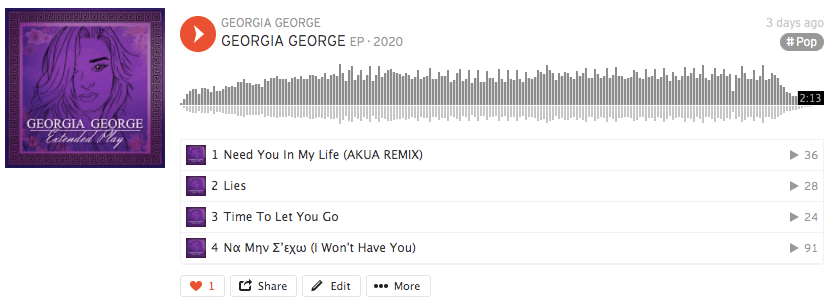
When deciding the track names with Connor, we noticed that all of the tracks were love themed, and we decided that this could be used successfully to tell a story through the music!
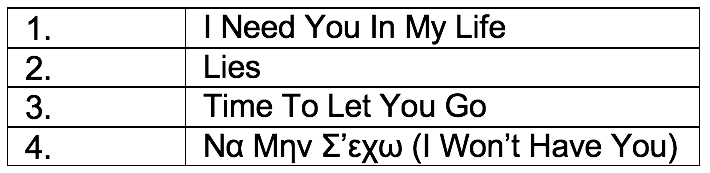
Below is the track names that we have come up with and in the order that is best suited:
When deciding on this track order, we did some initial research to inform our decision. This is something called album sequencing as highlighted by Hahn (2018) who suggests to consider a variety of areas such as ‘silence between songs’ and ‘fade-ins and outs between tracks’ when putting the tracks together, like a playlist. Hahn (2018) also further suggests to consider these three areas (adapted with my songs):
1. ‘Start Strong’ – Track that will grab attention into the EP > I Need You In My Life (AKUA REMIX)
2. Will I release some as singles? > LiesandΝα Μην Σ’εχω (I Won’t Have You)
3. Telling a story through the tracks > Each track order tells a story through love:
> I Need You In My Life (AKUA REMIX) – Really wanting that person in their life
>Lies – Finally have them, in a relationship but they have told lies
>Time To Let You Go – Lies have led to wanting to not wanting to be with them
>I Won’t Have You – Final decision – deciding they won’t have them back
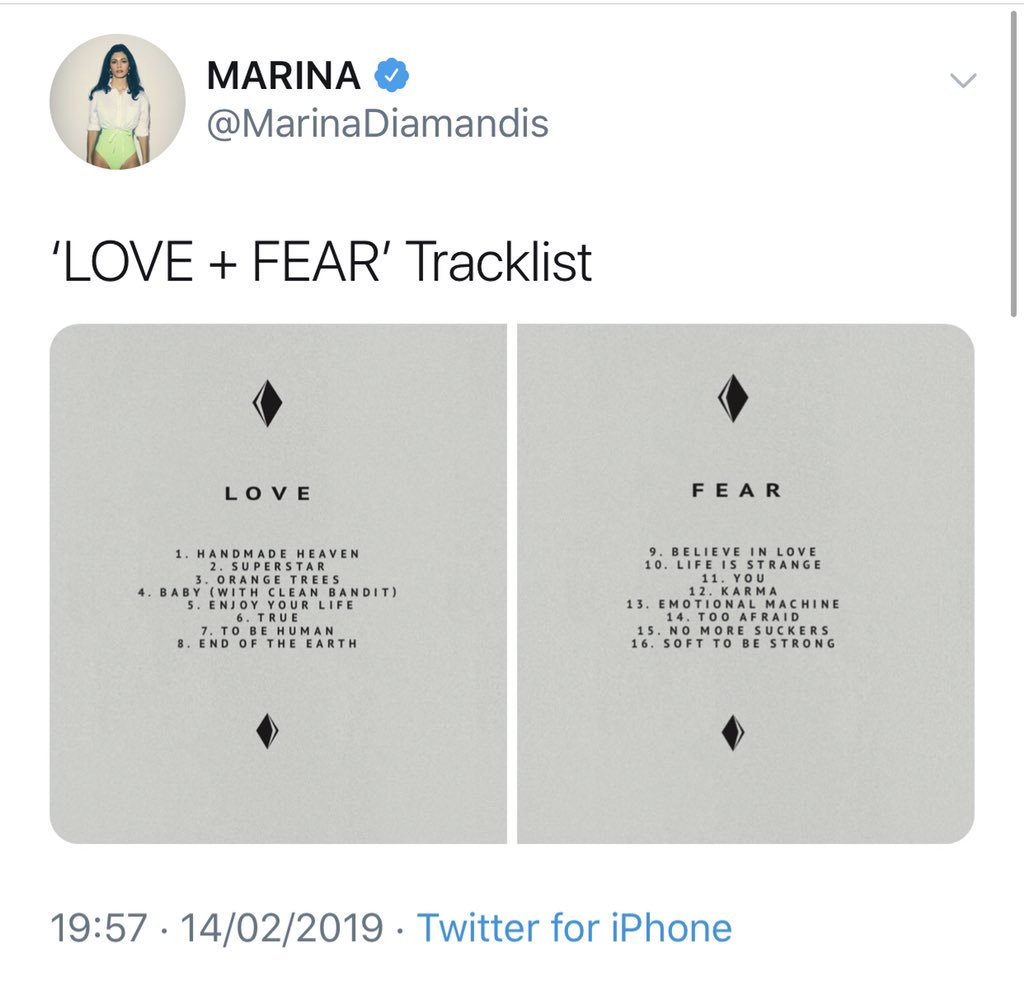
I mainly wanted to do this because it creates something more interesting to each track and the overall presentation of the EP. This is something done by other artists, for example, Marina and the release of her ‘Love and Fear’ album where different song narratives are put into either the love side of her album or the fear side, something she has promoted through Twitter –
Figure 27.0. – Marina Track List Promotion Tweet
Source: Twitter – @MarinaDiamandis
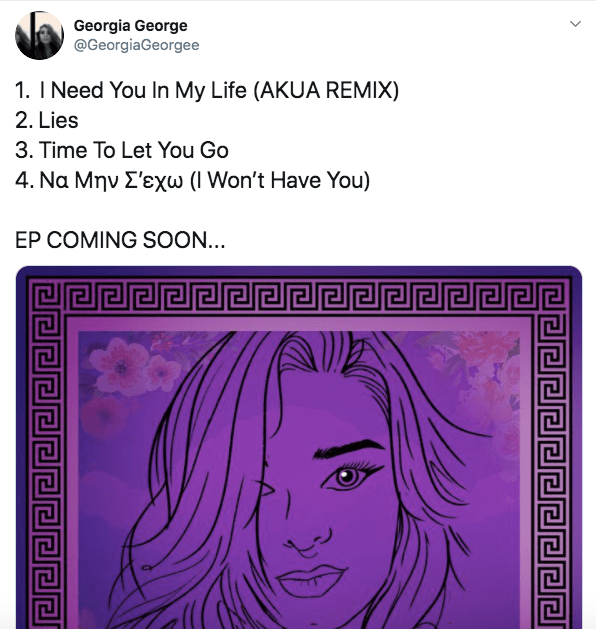
Figure 27.1. – My Tweet Track List Promotion
Source: Twitter – @GeorgiaGeorge
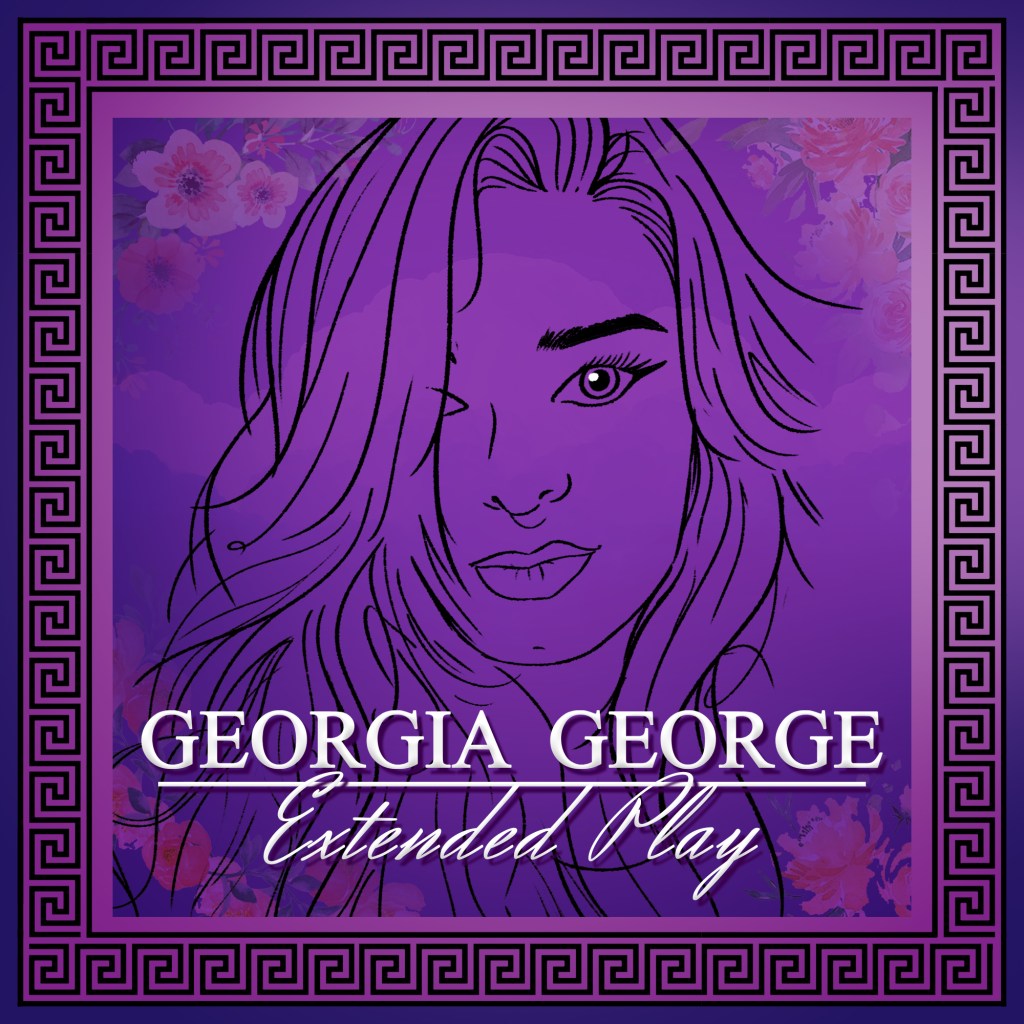
Why Extended Play Title on EP COVER?
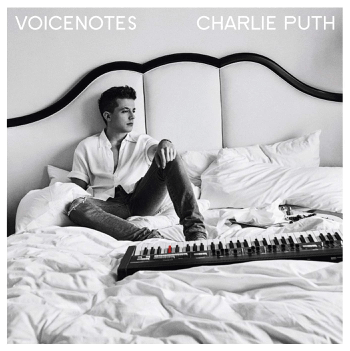
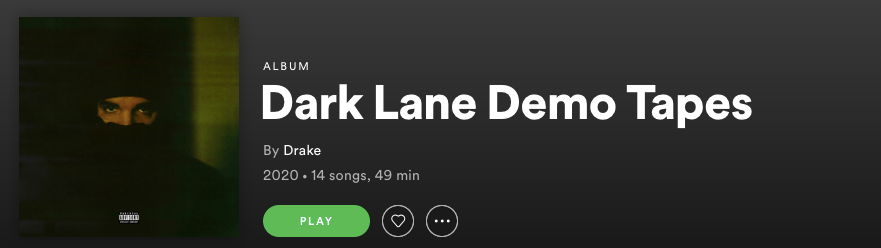
The reason as to why I have left the Extended Play as the title of my EP, is mainly because I feel like this title is somewhat straight to the point. Many artists today call their albums or EP’s something simple. For example Charlie Puth has titles his album ‘Voice Notes’ (2018) due to creating voice notes. This was also done similarly by Drakes recently released album called ‘Dark Lane Demo Tapes’ suggesting that they are demo songs. This is something I also wanted to initiate with my EP and being straight to the point, especially as it is my first EP created.
Figure 27.2. – Charlie Puth VoiceNotes Album
Source: Amazon
Figure 27.3. – Drake Dark Lane Demo Tapes Album
Source: Spotify
TARGET AUDIENCE:
Throughout the process of creating this EP project as a whole, I wanted to consider the target audience for this project in order to shape the project in such a way to maximise its appeal to it. My main aim from the release of this project through social media, is to mainly gain appeal to a wider audience not just through English Pop, but also to a expanded audience through Greek Pop. Moylan (p.80) states that ‘the target audience for a piece of music is often determined to help focus a project and to seek a way of predicting the success of the music in communicating its message’.
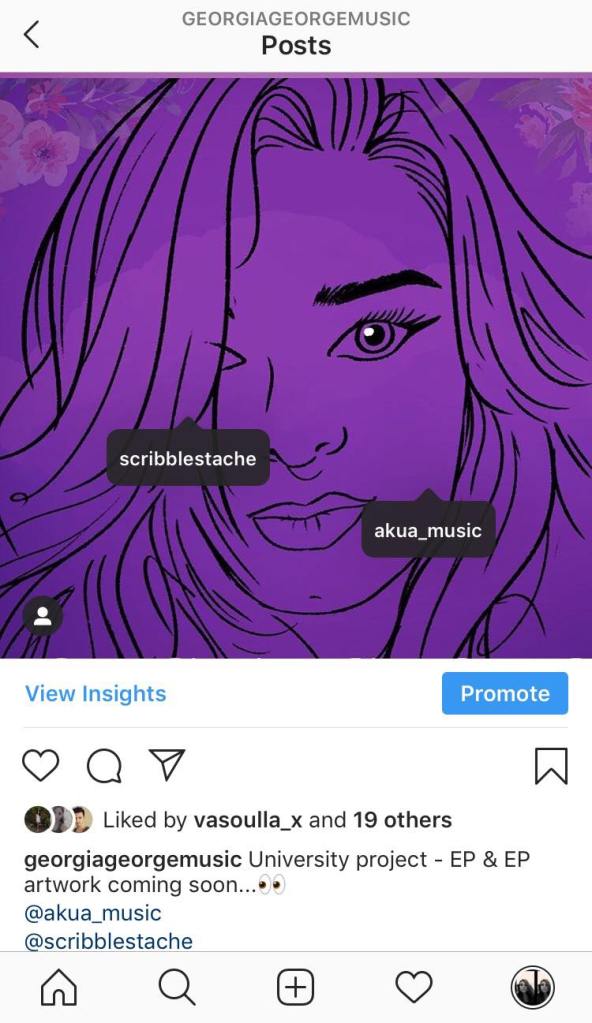
Chertkow (n.d.) also further suggests that creating and posting material will help to promote the album and release which can be done through posters. However, I have done this by posting on Instagram a ‘sneak peak’ of whats to be posted. This is something that many artists do before posting the final EP/Album in order to promote their music and gain attention. I have also tagged each collaboration AKUA (Connor) and ScribbleStache (Alex) to promote their work and collaboration –
Figure 27.4. – Instagram Promotion
Source: Instagram – @GeorgiaGeorgeMusic
OTHER PLATFORMSTOCONSIDER
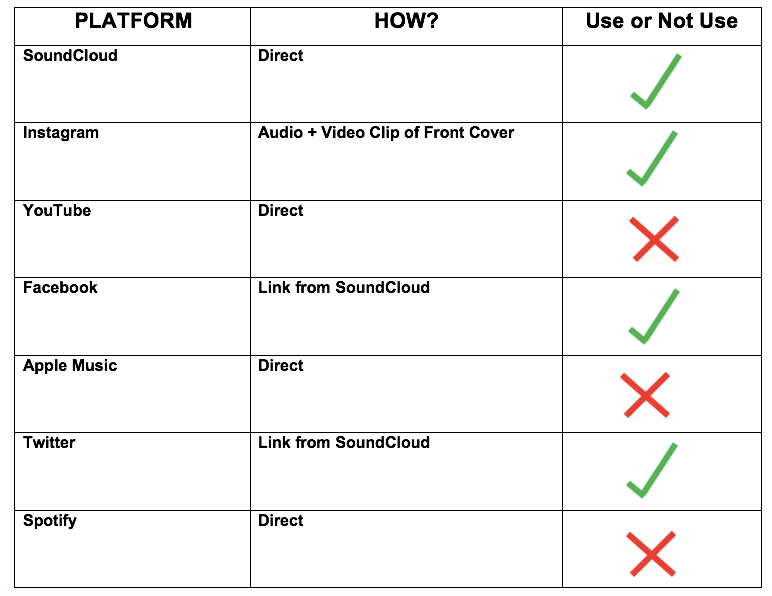
Figure 28.4. demonstrates the thought process of which platform I will be sharing and promoting my EP on. Although I have considered YouTube for music, something that has become quite a recent feature on YouTube for artists where you can ‘connect with fans in unique ways’ (YouTube, n.d.), I believe that this is something I can consider in the future if I were to further promote the tracks with music videos (something I did consider at the start of this project). The social media platforms that I will be using are also free for artists to use and promote their work on with no cost.
Figure 27.5. – Platform Decision
Given that I have considered other streaming services like Spotify and Apple music, because this is a the first EP that I have created, I believe that this EP is more of a promotion to gain popularity and bigger fan base rather than to earn money. This was also discussed with Connor who suggests that this project can be used primarily as a promotional tool to gain follower for both our music or upcoming projects in future.
Spotify:
Spotify is a popular platform where artists are able to upload their own music with ‘forty thousand tracks per day is the equivalent of 280,000 songs a week, or around 1.2 million tracks per calendar month’ (Ingham, 2019). However, although it is free to upload music to Spotify, there would be a charge through the music distributor (Promoly, n.d.), Spotify did attempt a feature called ‘Beta Program’ where independent artists were able to upload their music directly to Spotify, but was dismissed of during July 2019 (Spotify for Artists, 2019). Spotify FAQ (n.d.) also states: ‘To get your music on Spotify, you need to work with a distributor, or with a record label who already has a distributor’.
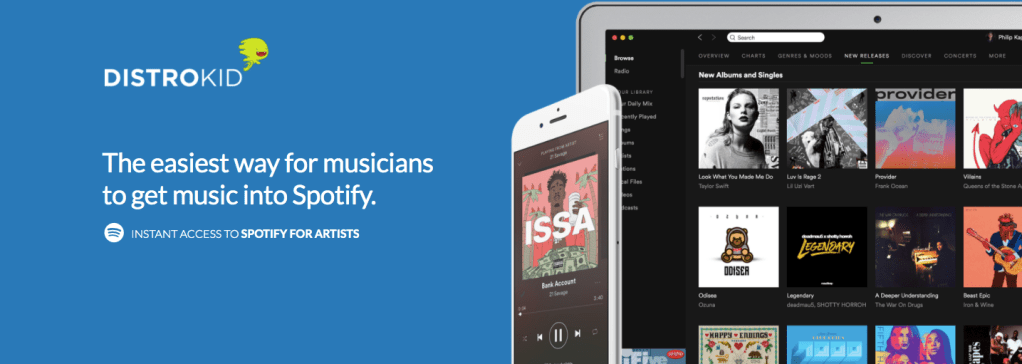
This can be resolved in future by signing up to a distributor and paying a price to upload my music like DISTROKID (n.d.) who charge $19.99 for a years worth of music that can be uploaded directly to Spotify (see figure 28.4.).
Figure 27.6. – Spotify Distributor
Source: DISTROKID, n.d.
Apple Music:
Apple music for artists also charges for artist profiles and music uploaded. Apple music requires artists to have a subscription, however, they do offer some free trials (McCauley, 2019). Obas (2019, p.11), states that ‘it pays artists about $0.008 per stream, and it’s the second globally used music streaming platform’. This is also something to consider in the future when releasing my own personal made music or again if I were to collaborate with other artists.
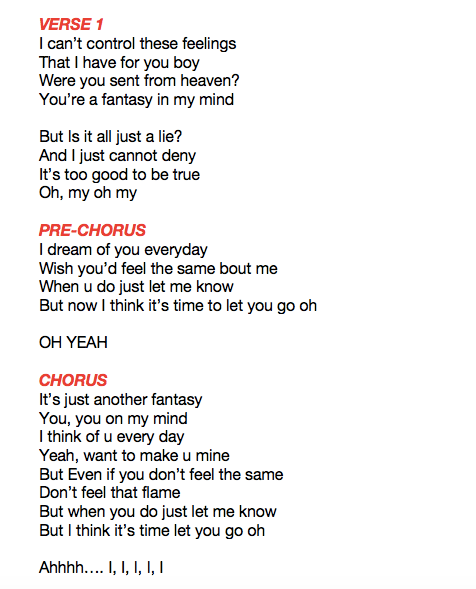
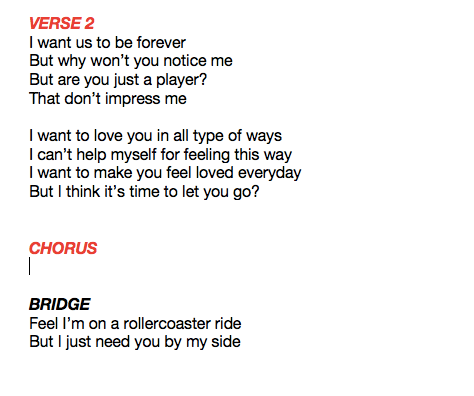
Below is the final vocals for the Reggaeton track so far. I am pleased with how they have turned out, however, the bridge still needs to be completed by creating lyrics and a melody.
Lyrics:
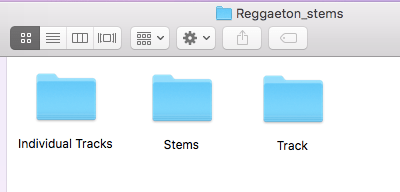
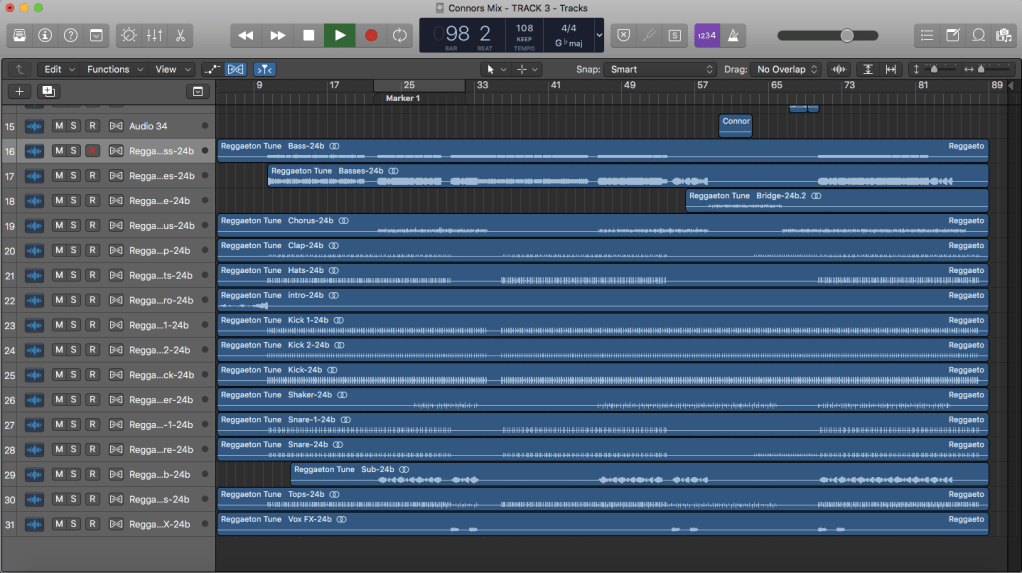
Now that nearly all the vocals are mostly complete it was now a case of mixing and mastering the track for a quality sound. In order to do this, me and Connor came up with the idea to bounce each instrument down without any FX effects from Logic Pro X (see figure 27.0.) and sending through ‘WeTransfer’. This is so that Connor can mix the instrumentation tracks using Ableton. This will then allow me to focus on the mix of the vocals myself and work with Connor online to focus on how to mix vocals in with the instrumentation so that I can learn these important skills for my own future projects!
Figure 26.0. – Reggaeton Instrumentation Mix
What Next?
My next steps for this particular track, is to mainly mix, master vocals with the instrumentation and complete the bridge. We also need to finish the other mixing and mastering of the other tracks as well as deciding their names and track order.
BLOG 25 – MIXING AND MASTERING
Now that 3 out of 4 songs are done in terms of structure, instrumentation and vocals recorded, it is important now to focus on the mixing and mastering stages. This is so that the overall production sounds complete.
Understanding Mixing
Mixing, as highlighted by Savage (2014, p,1) is after the instrumentation and recording stages where ‘elements need to be set for level, panning and processing (EQ, compression, reverb, etc)’. This is further enhanced by Nahmani (2018, p.2) who suggests ‘combining all elements into a cohesive whole, and at the same time keeping them sufficiently defined so that listeners can distinguish among them’.
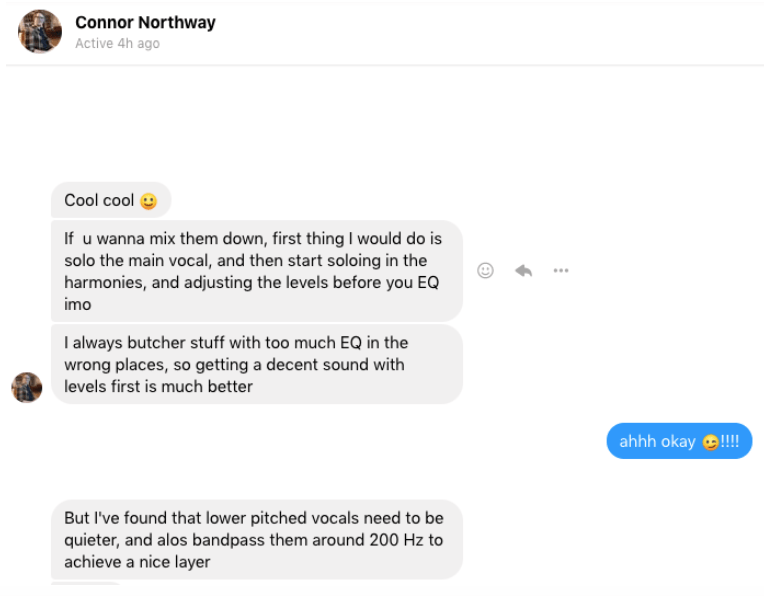
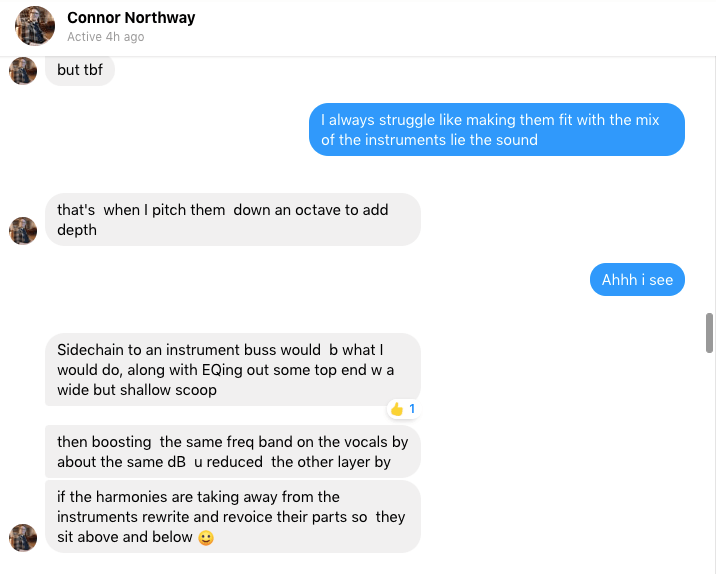
Connor was able to give me his input when mixing the vocals for each track –
We have also both looked at this video together on how to specifically mix tracks in Logic Pro X. I found this particularly helpful as it explains how and what EQ is used for:
Source: Youtube – Musician on a Mission
USING REFERENCE TRACKS:
Below are some reference tracks that we will be using during the mixing process. This is something producers do and can be used as a source of inspiration on the qualities that the mix holds Izhaki (2013, p.27). Mastering The Mix (2017), also highlights that it is important to choose a reference track that is in the same genre as your own track, this is something I have done below:
POP REFERENCE
Similar use of harmonies and double tracking during chorus
Main vocal line – stands out in the mix
REGGAETON REFERENCE
Dembow Rhythm reference
Harmonies and main vocal
HOUSE/DANCE REFERENCE
Vocal at the beginning
Vocal parts – Repeated
Similar bass rhythm and sound
Build up
GREEK POP REFERENCE
Instrumentation – e.g. guitar, drums
Main vocal and few harmonies
Understanding Mastering
After the mixing process, it is then important to master the track in order to as suggested by Landr (n.d.) ‘the goal of mastering is to ensure that your audio will sound the best it can on all platforms’. This means that there are 3 specific areas that are done to create this:
Louder Track
Completed/Clean track – ‘sound better’
Can sound good on all speakers or headphones – ‘To make the track more translatable to all different kinds of speakers’
Source, adapted from: Musician on a mission, n.d.
Strong (2005, p.16) also further adapts with 4 particular areas/ steps to follow when mixing and mastering each track:
Dynamics – Adjusting the overall volume of each instrument and also adjusting the EQ of each instrument and using compression
‘Tonal Balance’
Matching each song volume
Song sequence
What Next?
Now that these 3 songs have been mixed as an initial starting point, it is not important that I really try to finish the Reggaeton track which is a bit behind on the development.
Finish Reggaeton track – vocals and mixing
Further mix and master each trackwith Connors help
Begin to think about how I will post each track – track names, track order
Musician on a Mission. (2019). (Online Video). Mixing in Logic Pro X (Everything You Need to Know). Available at: https://www.youtube.com/watch?v=vry9ZDGr56E [Accessed 24th April, 2020].
Nahmani, D. (2018). Logic Pro X 10.4 – Apple Pro Training Series: Professional Music Production. Peachpit Press.
Savage, S. (2014). Mixing and Mastering in the Box: The Guide to Making Great Mixes and Final Masters on Your Computer. Oxford University Press.
Strong, J. (2005). Home Recording For Musicians For Dummies. Hoboken: John Wiley & Sons.
Helena Paparizou. (2017). Έλενα Παπαρίζου – Αν Με Δεις Να Κλαίω (Official Music Video) ft. Αναστάσιος Ράμμος. (Online Video). Available at: https://www.youtube.com/watch?v=R4rM-6eQMlc [Accessed 24th April, 2020].
ROSALÍA. (2019). ROSALÍA, J Balvin – Con Altura (Official Video) ft. El Guincho. (Online Video). Available at: https://www.youtube.com/watch?v=p7bfOZek9t4 [Accessed 24th April, 2020].
Izhaki, R. (2013). Mixing Audio: Concepts, Practices and Tools. Oxford: Taylor & Francis, 2 May 2013.
I have now completed all parts of the vocals for the pop song! I am very pleased with the outcome of these vocals and I have ensured that a good use of harmonies have been used throughout the track. This was in order to create a choir like sound to the track, bringing the vocals out more. Albano (2016) further enhances that ‘there’s more to creating good vocal harmonies than just using pitch shifting software‘, this is something I didn’t want to do, mainly because I wanted to create a more natural sound to the vocals, however, we both experiments with some parts of the main track by using ‘pitch shift’ plugin creating a lower pitched voice effect.
I then sent the track with all the vocals to Connor who then gave me his opinion –
It is now a case of mixing and further editing the arrangement of the track as suggested by Connor. Below shows the various points that Connor makes of the track so that I can try mixing it myself on Logic Pro X.
What Next?
Mixing is definitely needed for this track and this will be explored in the next few blogs.
Research into understanding mixing and mastering
Continue to work with Connor of the overall sound of each track
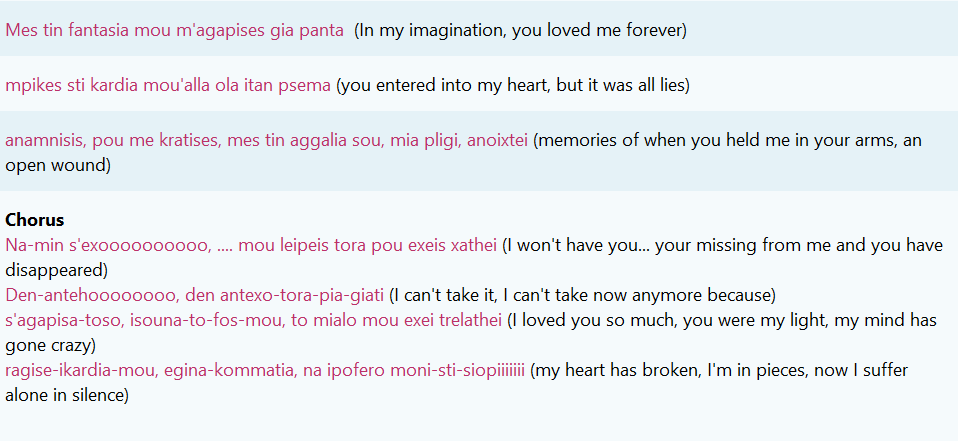
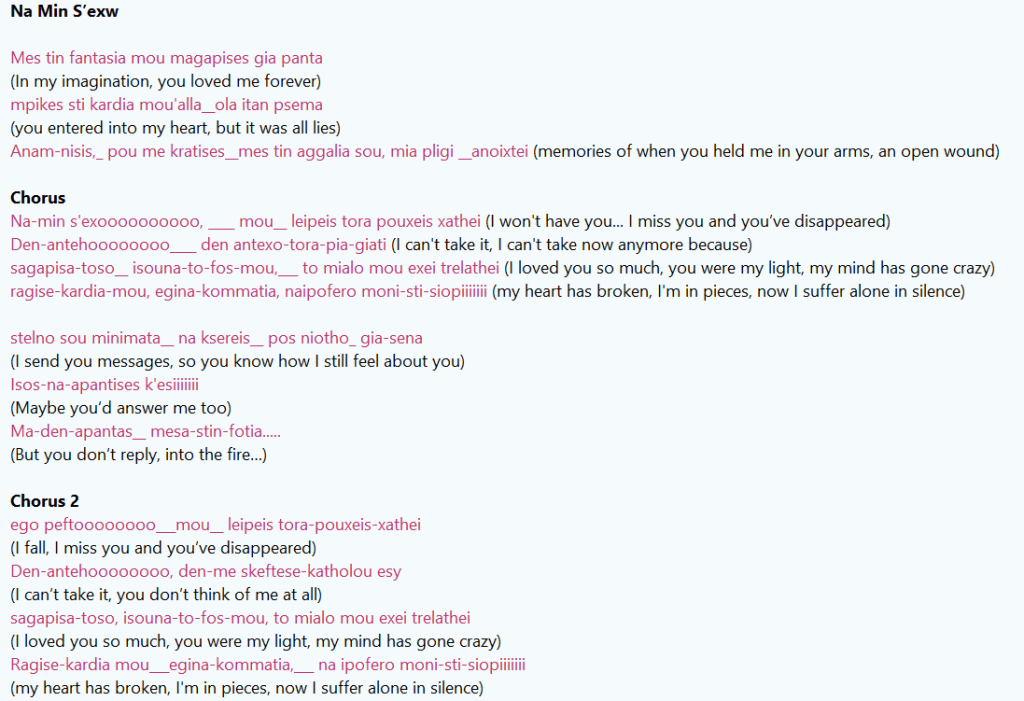
Below is the first draft of the Greek lyrics (translated in English) for the first verse and chorus. When writing these lyrics, I have collaborated with my brother, also a musician who is able to write Greek lyrics and play guitar! This was very helpful because being able write Greek lyrics that make sense is very difficult process.
Figure 23.0. – Part One Lyrics
Figure 23.1. – Part Two Lyrics
So far for this track I have recorded the vocal for the first verse. I now need to record the rest of the lyrics that have been formed and this well then be sent to Connor who will advise me on how to mix the vocals, or may even be able to do this through Ableton.
Verse One Recorded
What Next?
Now that the Greek track is almost finished, I need to ensure that all vocals stand out in the mix with some use of harmonies. Continue with the other tracks in terms of mixing.
BLOG 22: RECORDING TECHNIQUES
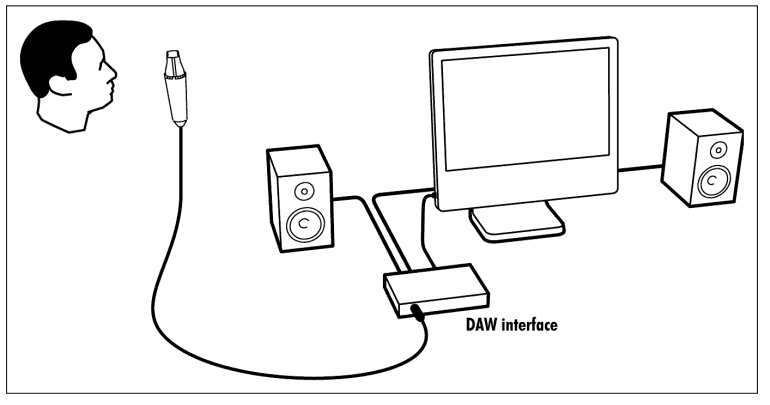
When recording the vocals at home in my own space, it is vital that I am able to produce professional sounding vocals even with a small amount of equipment and in a small space. Below demonstrates a simple set up for recording vocals.
Figure 22.0. – Setup and inputs/outputs
Source: Savage, 2011, p.8
Recording at home: What Is Needed?
Hunter (2012), suggests that there isn’t a great deal of tools/equipment that are needed to create or record at home, the only ones that are mainly needed are:
DAW (digital audio workstation)
Hardware Interface
Speakers
Headphones
Microphone and cable
Microphone Stand
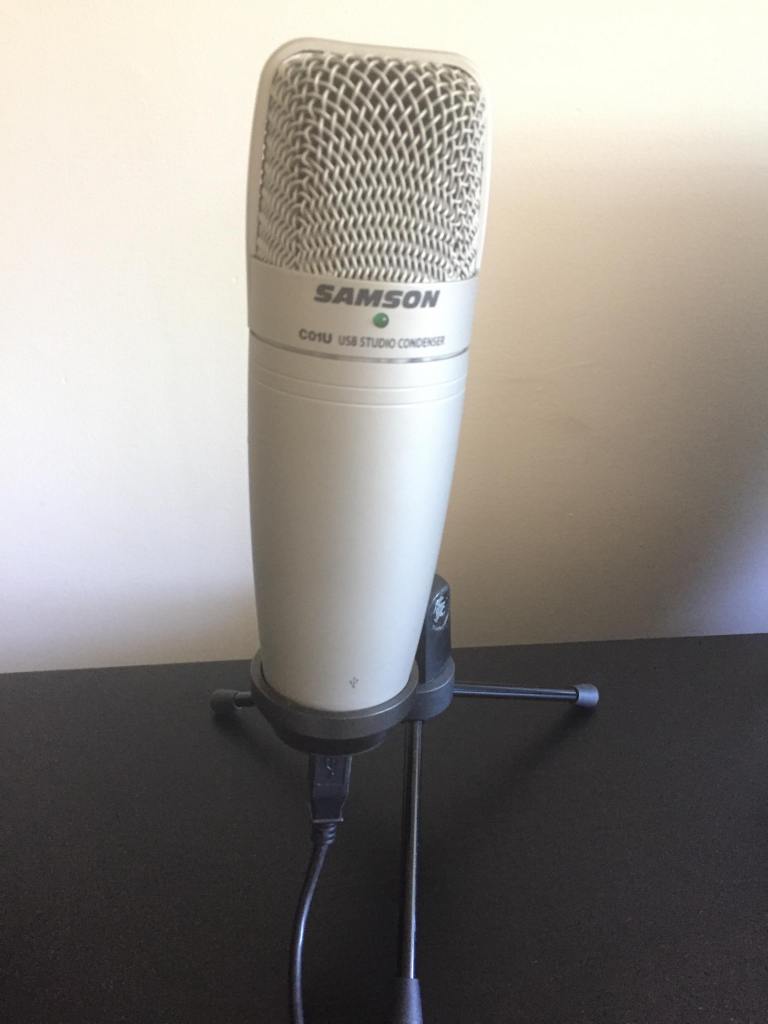
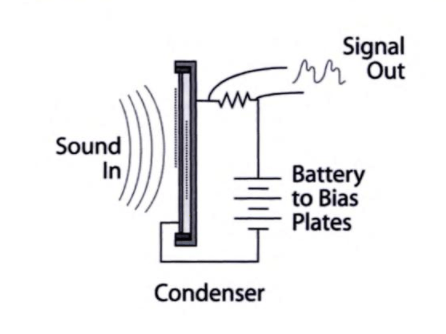
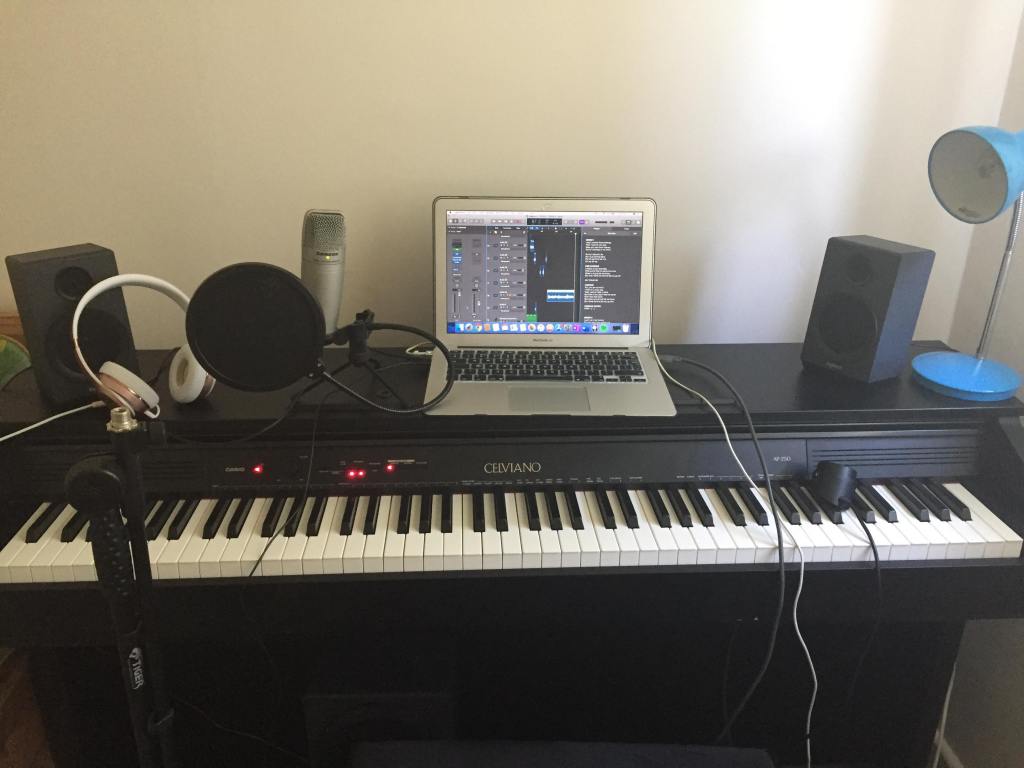
From this list, I have everything except a hardware interface. This is because normally when recording my vocals and because I am still at a beginners stage of creating and recording music, I plug my microphone using a USB cable from my SAMSON C01U Pro Condenser microphone (as pictured below). However, Hunter (2012) states that ‘the equipment with which you populate your home studio can be as sparse as the bare minimum necessary to plug in and record a voice or an instrument’.
Figure 22.1. – Condenser Diagram
Source: Owsinski, 2005, p.6
I also have a pop filter/shield that I use for my microphone, which is particularly helpful for pops, heavy breathing or any other sounds that I do not want to be heard in the recording (Owsinski, 2005, p.21).
Figure 22.2. – Home Set Up (Beginners)
Although this setup space is small and has limited equipment, it has still been positive in the creation of creating each track! ‘today’s home studio owners and amateur musicians have access to much of the same technology that used to be the sole territory of the professional recording engineer’ (Truesdell, 2007, p.xxvi). Billie Eilish, a popular singer today and her brother, a producer who has produced multiple tracks in a small space (see video below).
Source: YouTube AWAL Channel
Source: Youtube Rolling Stone Channel
This is a perfect example of how me and Connor have collaborated. Although we did have to move to online collaboration, our work so far has still been very positive and we are still able to learn important skills from each other. This was also shown face-to-face when working with Connor who was also able to teach me some skills (see video below)
What Next?
It is now important that I focus more on the vocals, in terms of harmonies. I also need to ensure that I record vocals for the Greek song and finish any gaps in the other tracks that need re-recording! This will then be sent to Connor who will be able to advise me.
Reference List:
AWAL. (2019). SPACES: Inside the Tiny Bedroom Where FINNEAS and Billie Eilish Are Redefining Pop Music. (Online Video). Available at: https://www.youtube.com/watch?v=ZBJ914ha6LQ [Accessed 2nd April, 2020]
Hunter, D. (2012). The Home Recording Handbook: Use What You’ve Got to Make Great Music.
Owsinski, L. (2005). The Recording Engineer’s Handbook. Hal Leonard Corporation.
Savage, S. (2011). The Art of Digital Audio Recording: A Practical Guide for Home and Studio. New York: Oxford University Press.
Truesdell, C. (2007). Mastering Digital Audio Production: The Professional Music Workflow with Mac OS X. John Wiley & Sons.
BLOG 21 – ALL TRACKS CURRENTLY
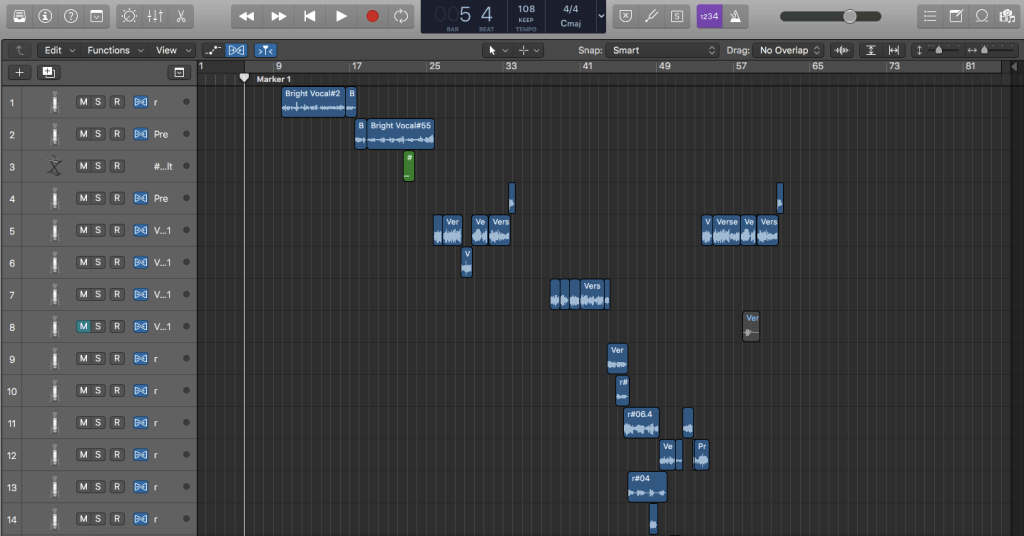
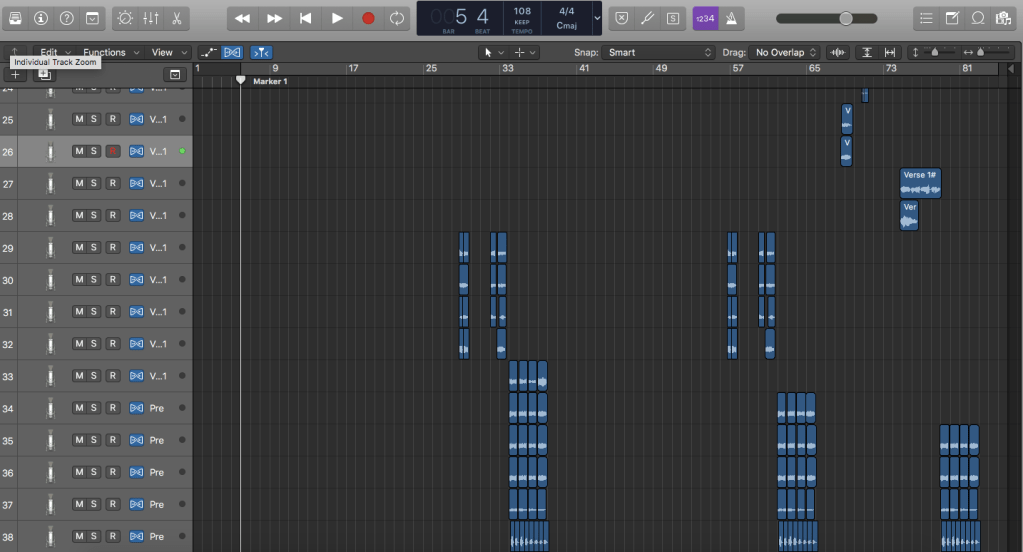
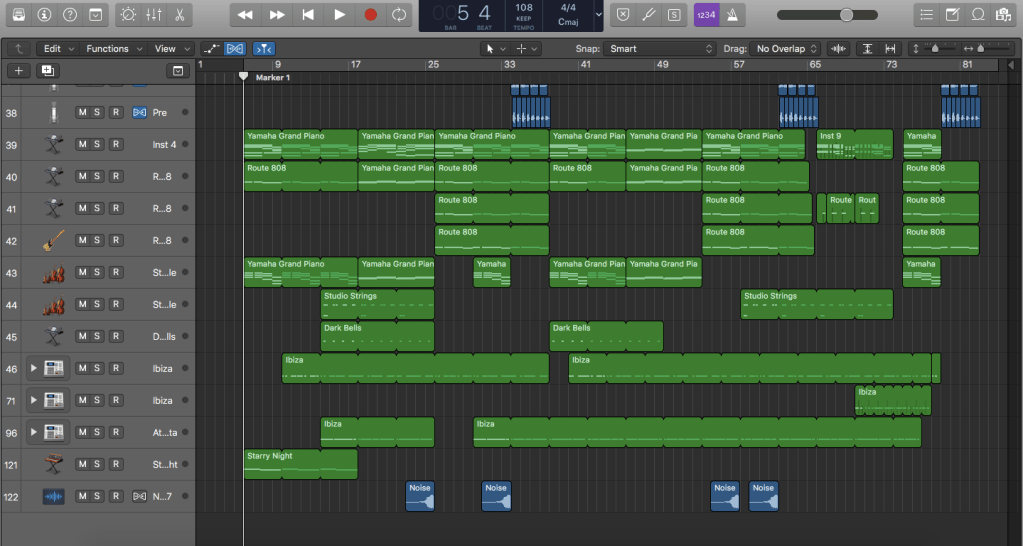
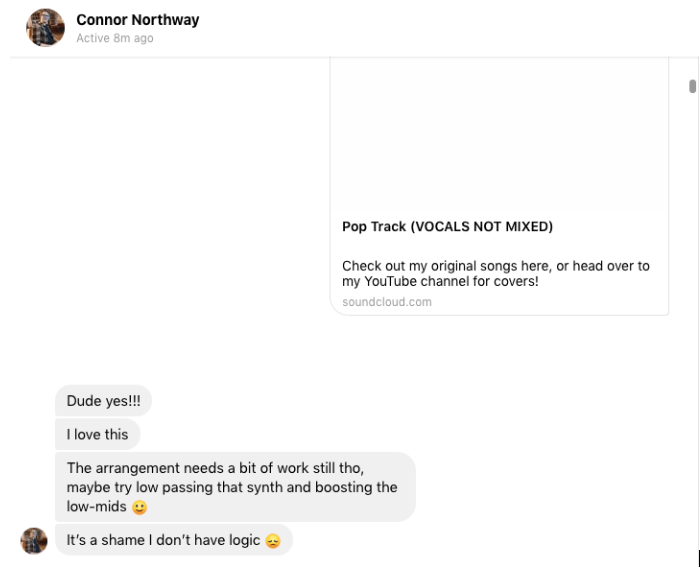
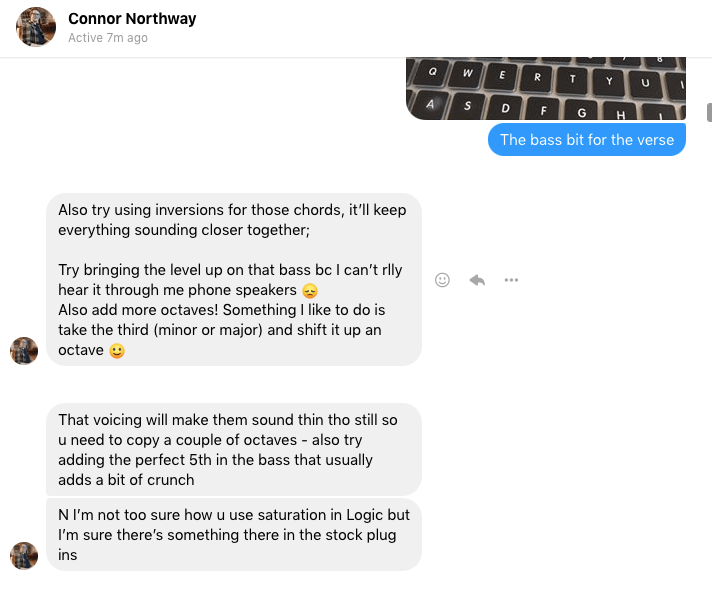
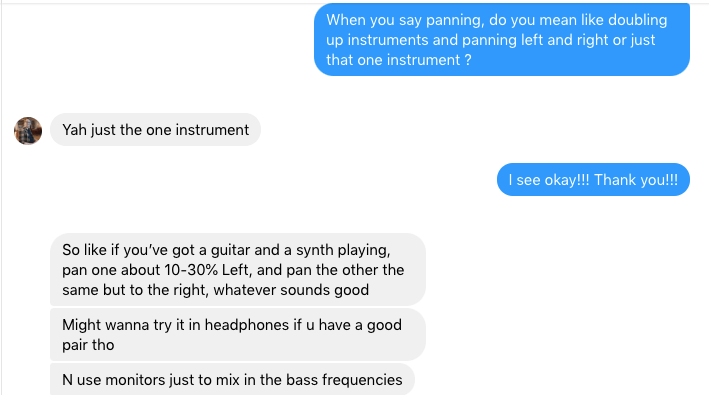
Below is the progress of each track so far. It is clear that there is still a lot of work to be done in terms of arrangement and the overall quality (the mix). This is due to issues with being able to work face-to-face and being able to communicate ideas to progress this project effectively.
 GEORGIA PAPANICOLA